Dr. Nath is a nerve surgeon for Brachial Plexus Erb's Palsy
Dr. Nath Stand Up MRI is now available

The Stand-Up Have an MRI while watching t.v. comfortablyMRI scans patients standing

Dr. Nath is one of America's Top Doctors

click to sign up for Dr. Nath's Newsletter


Brachial Plexus surgery for Children and Adults
Texas Nerve & Paralysis Institue of Texas
View all procedures performed at the Texas Nerve & Paralysis Institute
Brachial Plexus
Winging Scapula
Neurofibromatosis
Foot Drop Injury
Prostate Injury
Catastrophic

2201 W. Holcombe Blvd.
Suite 225
Houston , TX 77030
[ Map ]

Toll-Free
(866) 675-2200

Telephone
(713) 592-9900

Fax
(713) 592-9921


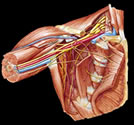
Anatomy of the Injury

Winging of the scapula due to long thoracic nerve palsy is a common diagnosis and should be treated as a significant functional problem. It must be recognized that scapular winging is not simply an aesthetic issue; the compensatory muscular activity required to improve shoulder stability is associated with secondary pain and spasm due to muscle imbalances and tendonitis around the shoulder joint. Other described resultant anomalies include adhesive capsulitis, subacromial impingement and brachial plexus radiculitis .

Winging Scapula ^ Entrapment of the suprascapular nerve results in a diffuse, deep, aching pain in the posterior and lateral aspects of the shoulder and the arm.

Traditional management has relied on conservative therapy and in some refractory cases, pectoralis tendon transfers for stabilization of the scapula. Scapulothoracic arthrodesis is considered in other instances. Probably in most patients, surgery is not undertaken and relief of symptoms is inadequately obtained. Chronic shoulder instability and pain are the result.

Scapular winging often results from insults to the long thoracic nerve. Part of the susceptibility of the nerve to injury arises from unique anatomical features. The nerve itself is small in diameter and fragile- appearing, in contrast to the relatively robust adjacent nerves of the brachial plexus. The lengthy course of the nerve from its C5 through C7 root origins through to the inferior border of the serratus anterior muscle also presents multiple anatomic locations for potential injury. Surgical dissections in the axilla as during mastectomy can cause direct injury to the nerve in the infraclavicular region, with an incidence as high as 30%.

Perhaps the most important anatomic feature associated with injury is the course of the long thoracic nerve through the fibers of the middle scalene muscle in the supraclavicular region. Several patients in the current study were thought to have sustained an insult to the nerve through direct compression by the middle scalene muscle during contraction while exercising. Another category of patients included those who sustained a direct extrinsic crush to the nerve in the region of the middle scalene muscle; in this group, the middle scalene was thought to be a possible secondary source of injury.

The anatomic basis for long thoracic nerve injury by the middle scalene was first described by Skillern in 1913: "the long thoracic nerve is exposed to trauma as it traverses the scalenius medius". The proposed mechanism for injury has been succinctly described by Birch and colleagues: "stabilization of the forequarter on the chest wall [is] commonly associated with a strong sustained inspiration…[this action will] bring the scalenius medius into action to stabilize the first rib and the thoracic cage…[therefore] there is a liability to trapping of the nerve to the serratus at or near its point of emergence from the muscle". Certainly in our experience, strenuous upper extremity activity or a history of lifting heavy weights is present in most patients. Two patients had a specific history of direct compression of the supraclavicular fossa during deep massage treatments with associated pain and paresthesia during treatment.


What is the extent of your injury?
First Name
Last Name
Email
Phone
 
How did the injury occur?
When did you notice the winging?
Besides the winging, are the shoulder and
arm weak?
What is your specific question regarding Winging Scapula?


This website is intended as an informational resource only for families and patients suffering from peripheral nerve injuries.
No attempt to provide specific medical advice is intended. It is not intended to infer that surgery is always the best
choice for a particular nerve injury. You should always contact a specialist directly for diagnosis and treatment of your
specific problem, and a second opinion is always a good idea.

Copyright 2002 - 2003 | Privacy Policy | Website Maintenance by ServerSideDesign.com | Site Map
Dr. Nath is a specialist in: Brachial Plexus Injury (Erb's Palsy), Winging Scapula Injury (Long Thoracic Nerve Palsy),
Neurofibroma and Schwannomatosis Nerve Tumors, and Nerve Surgery to correct Impotence after Prostate Cancer Surgery